Content | Exhibition
| Calendar | Participants
| Links
Content | Exhibition
| Calendar | Participants
| Links
Election Laboratory
By WochenKlausur
In view of the coming parliamentary elections the Vienna based artist group WochenKlausur wants to examine the
election mode with an experimental project that will take place in Stockholm. Each democracy legitimatises its
government through elections. Yet he formation of majorities and the thus determined politics are not only the result of the citizens' will, but also of the election mode. The party composition of parliament would for example look different had the voters the possibility to vote parties out.WochenKlausur wants to show that each election mode has effects on the election result. Within the context of the
exhibition public opinion there will be held fictitious parliamentary elections with different possibilities of
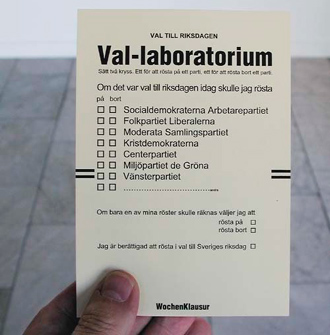
voting in the center of Stockholm from 22nd August until 15th September 2002. Among others there will be the
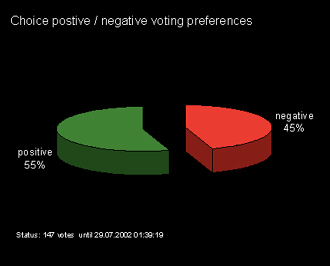
possibility of negative voting. This means that a party that in the opinion of the voter should not be represented in
parliament can be voted out. The project of WochenKlausur offers the possibility of voting positive, negative or both: the eligible voters decide if they want to confirm a party, vote out a party or want to use both possibilities.Art and Sociopolitical Intervention
The artist group WochenKlausur has been conducting social interventions since 1993. The concept of intervention, whose usage in art has undergone an inflationary trend in recent years, is often used for any form of change. In contrast, WochenKlausur, at the invitation of art institutions, develops and realizes proposals - small-scale but very concrete - for improving sociopolitical deficits. In the context of many twentieth-century artists who understood how to actively take part in the shaping of society, WochenKlausur sees art as an opportunity for achieving long-term improvements in human coexistence. Artists' competence in finding creative solutions, traditionally utilized in shaping materials, can just as well be applied in all areas of society: in ecology, education and city planning. There are problems everywhere that cannot be solved using conventional approaches and are thus suitable subjects for artistic projects. Theoretically, there is no difference between artists who do their best to paint pictures and those who do their best to solve social problems with clearly fixed boundaries. The individually selected task, like the painter's self-defined objective, must only be precisely articulated. Interventionist art can only be effective when the problem to be solved is clearly stated.
WochenKlausur
It all started in the winter of 1992. For an exhibition at the Vienna Secession, Wolfgang Zinggl invited eight artists to work on solving a localized problem. Within the normal time span of an exhibition, the group was to work in closed session to develop and realize a small but concrete measure to improve conditions for homeless people. This first project succeeded in making medical care available to this group. Since then, a mobile clinic has treated more than seven hundred homeless people per month free of charge. An invitation from the Zurich Shedhalle followed, where WochenKlausur - in a new line-up - developed a pension for drug-addicted women. A year later, the group established a social center with bocce court for the older residents of the Italian community Civitella d'Agliano. In Graz, seven immigrants were assisted in obtaining legal residency in Austria. Interventions in Salzburg, Berlin, Venice and Fukuoka followed. A total of twelve interventions have been successfully conducted in recent years by alternating teams that have involved a total of over forty artists.