Content
| Exhibition | Calendar
| Participants | Links
Content
| Exhibition | Calendar
| Participants | Links
The Castle
By Åsa Andersson-Broms och Karin Hansson
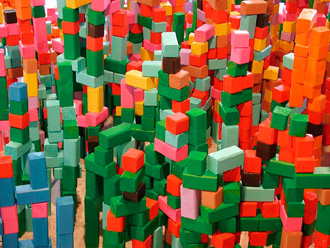
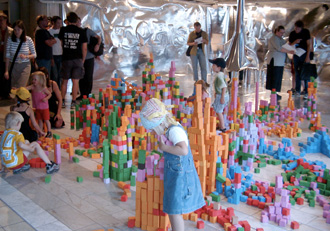
A half razed, half built-up castle, made of blocks of bright colors, is on the floor at the exhibition. The blocks represent Sweden’s whole population and the colors symbolize different life-style groups. The visitors themselves can build the castle from these demographic statistics. If everyone helps one another, it can perhaps finally be finished.
This Is Where We Come from
“Gasoline and iron stoves: Here, values such as traditionalism, individualism, and materialism dominate. The interest in saving energy is just as great as the interest in dogs, cats, cars, and carpentry, along with fishing and camping. There are plenty of cordless telephones, motorboats, outboards, rowboats, video games, and kitchen appliances. [---] Here we find the country’s highest possession of iron stoves. Transport cart, trailer homes, and snowmobiles are also popular. One reads the evening paper occasionally, while the big city morning papers are read very seldom indeed. The local morning papers have a pretty good deal.”(1)
This Is Where We’ve Ended up
“The pulse of the big city: The regions are characterized by the presence of many globally minded people, inclined towards change. These people are extremely interested in the culture and foreign policy of other countries. In addition, they like to go to concerts, theater, to listen to classical music, as well as go out to pubs and restaurants. Activities such as extreme sports, riding, sailing, and snowboarding and slalom are also very popular. On the other hand, these cosmopolitans are not at all interested in cars, child care or their illnesses. They read the big city press zealously.”(2)
A Classification of SwedenÕs Inhabitants
Such are the rungs of our social ladder, according to the MOSAIC system(3), which has the entirety of Sweden’s population classified and searchable down to the level of the household and the postal code. MOSAIC is an immensely valuable resource for those who will survey their target group, be it in order to sell sausages or to sell an ideology. Every citizen is a potential consumer. The system brings into sharp relief what we are, what we want, and what we do. The key to SIM-city. A dream tool for the architecture of society. Tell me your postal code and I’ll tell you who you are! Tell me your postal code and I’ll tell you which political party agrees with your values and best looks after your interests!
The public opinion
It is representatives from these life-style groups who are questioned when opinion-polls are done. They are “the people.” The public opinion drives the careful production plans of jam manufactures just as much as the campaigns of political parties.
Jam manufacturers no longer need to sell the finest jam. The parties no longer need to foist their ideology on us. Instead, we can all be given individualized solutions based on our typical profile. Tell me what you want and we will make it our policy! The flexible jam for all occasions, now in thirty-four different flavors!Life-style types
Thirty-four flavors for thirty-four life-style types. In The Castle we have divided the life-style groups into nine main groups.(4) They are represented by nine colors —
Purple block: Well-educated big city inhabitant
Red block: Low- and middle-income employed person
Beige block: Retiree
Orange block: poorly educated from smaller municipalities
Yellow block: Younger, low-income worker
Blue block: Well-to-do house-owner
Turquoise block: Living in a row house or single-family house
Pink block: Middle-income employed person in a region with single-family homes
Green block: CountrysideA Castle Made of 8900 Blocks
Each block represents 1000 individuals. In total there are 8,900 blocks. 35,077 individuals are, according to the statistics, approximately like us. They have received their own block, which is black.
Together, we shall build the castle using all the blocks. The work will take place during the course of the exhibition, and will be done by anyone who wants to play social planer.
An authentic castle with towers and pinnacles and a moat. Or rather, if one thinks about it, a whole city with surrounding countryside. Once you’ve arrived, there’s no going back.Footnotes
1. http://www.marknadsanalys.se/index.asp?page=livsstil, 2002-08-06, postnummer [postal codes] 865 51 and 781 95.
2. http://www.marknadsanalys.se/index.asp?page=livsstil, 2002-08-06, postnummer [postal codes] 121 31 and 112 28.
3. The bases for the selection tool, ODR Mosaic, is a geodemographic classification of Sweden’s population. Geodemographics is the division of target populations on the basis of geographical regions and statistical facts. People who live in a particular region tend to be similar to one another in essential respects; at the same time, they can be clearly distinguished from people who live in other regions. The company, MarknadsAnalys AB, has, with the help of Statistics Sweden (Statistiska Centralbyrån — SCB), divided Sweden into small geographic regions, so-called Mosaic-regions. The smallest geographical regions are 250 x 250 meters. There are 68,000 Mosaic-regions where, on average, there are fifty households. Statistical information has then been obtained from SCB, The Registry of Realty, The Registry of Motor Vehicles, and Bonnier’s financial information fact book. A grouping of all Mosaic-regions has been created based on the most important statistical criteria. The thirty-four life-style types which resulted were then fleshed out with information from investigations such as Orvesto Konsument [Orvesto Consumer] and Konsument Monitorn [The Consumer Monitor] which includes people’s interests, their real estate and other holdings, and their consumption of media. Posten, http://195.42.222.20/opener.asp. 2002-08-06.
4. The division comes from The Swedish Postal Service’s Web site, http://195.42.222.20/opener.asp; note that the original division is based on households, which we converted to individuals. 2002-08-06.