Content
| Exhibition | Calendar
| Participants | Links
Content
| Exhibition | Calendar
| Participants | Links
The Average Citizen
By Måns Wrange and Igor Isaksson
A sociopolitical experiment where the views of an average citizen are spread to the population she statistically represents, via the use of professional lobbying, and the molding of public opinion.
The notion of an “average citizen” – that is, that a fictional person is able to represent a larger group of people – has been one of the most influential ideas in the construction of the Swedish welfare state. By incarnating modernity’s dream of translating a complex reality into a rational and easily surveyed model, statistical averages have constituted the very basis of the Swedish social engineering feat, in that they serve as the foundation for research, social debate, and the authority’s planning of most public sectors of society that affect the citizen’s daily life. (2) But other parts of society, such as industry, trade, the media, advertising, and the service sector, accommodate their services and products to a great degree to the average preferences of the clientele on which they focus. (3)
The Foundation of Representative Democracy
The principle that a single citizen can represent a larger population group constitutes last but not least the foundation itself of representative democracy. However, between the statutory influence at the ballot box every four years, the citizen’s direct political influence is rather limited. One is reduced to writing to her delegate, or contacting the local member of parliament, in order to try to gain a political hearing for one’s questions. The media also offer the citizen a certain platform, for example the Letters to the Editor section of daily newspapers, or radio programs such as “Ring P1” and “Klarspråk” [Straight Talk], or SMS messages in TV debate shows. But these channels often have a more symbolic than real political effect.
Today the question is not simply about the formal right, to say nothing of the practical possibility, of entering a question in the daily political agenda. Increasingly, the question is rather about who is the one entering the question, and how, and in what context, it is done. This fact is confirmed to no small extent by Inquiry into Democracy, which was commissioned by the government. The report describes, among other things, how decision-making has become more informal where personal contacts and networks, rather than traditional political meetings and campaigns, are more significant. The formal decision-making process in representative bodies is increasingly challenged by the evermore sophisticated campaigns of pressure groups, consisting of a combination of opinion-polling, opinion-formation, and more direct lobbying.An Alternative Model of Democracy
The Average Citizen project is a social-political experiment with an alternative model of democracy which proceeds from the foregoing de facto state of affairs. Because elections take place with a relatively long time span between them, public opinion polling and statistical research are some of the few possibilities the powers that be have to sound out the views of the voters. More often than not it is the average voter to whom political parties conform their platforms. Statistics and opinion polling thus already constitute a fundamental and occasionally decisive factor in political decisions. (4) The Average Citizen project takes this development to its logical conclusion by quite simply reversing the representation: instead of the citizens choosing their political representatives on the basis of how they believe the candidates represent their views, one person is chosen to be a proxy for the citizenry as a whole via a purely statistical representation of the population’s living conditions. This is a method which does not depend on the statistically representative persons’ political contacts, social networks, charm in the media, nor financial resources – factors that are becoming more and more determinative within Swedish politics.
An Average Citizen with Access to the Language of Power.
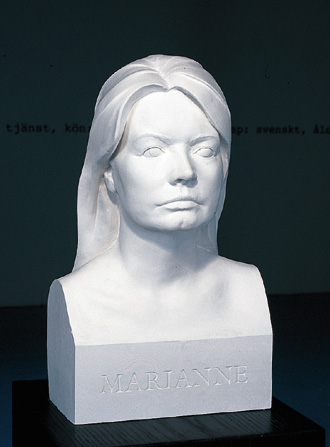
The alternative model of democracy in The Average Citizen is structured in the following way. With the help of Statistics Sweden, a statistical “profile of the average citizen” has been created by compiling the average values most commonly used by Swedish authorities. Afterwards, a person corresponding to this statistical profile – woman, forty years old, single, no children, living in a home with two rooms, a kitchen, etc. – was sought via a media campaign. Someone fitting the profile named Marianne indicated an interest in participating in the project. In order not to exploit her private life Marianne will be known publicly only by her first name. The goal of the project is rather to focus on her views on how society can be changed, as well as spreading these thoughts back to the Swedish populace, represented by her in this purely statistical way. This is achieved by giving Marianne access to the same advanced methods politicians, special interest groups, and industry make use of in order to bring about changes in society: professional creation of public opinion and lobbying.
Long-term Lobbying.
In coordination with Igor Isaksson and the project’s network – consisting of, among others, a lobbyist, a dramaturge, a copywriter, and an expert political advisor from the Swedish Government Offices – a long-term strategy has been established for how the views of Marianne, the average citizen, shall be implanted in Swedish society and, in the long run, influence the public opinion. Marianne was deep-interviewed concerning how society can be changed, and these views were then compiled in an opinion database. A political speech-writer and a copywriter, in consultation with Marianne, have summarized and formulated her views in the form of short, quick-witted slogans. A broad spectrum of Sweden’s most influential people from sectors which carry great weight – for example politics, advertising, media, and culture, both popular and otherwise – were then contacted in order to prevail upon them to work with Marianne by spreading some of her views in a public context they would find fitting. As in all effective lobbying and opinion formation, Marianne’s views are presented indirectly, without the general public being conscious of who is sending the information.
The Right Channels Lend Legitimacy.
One of her opinions, for example, has served as the point of departure for an editorial in one of the largest morning newspapers, it has been presented as a rejoinder in a much loved TV series, it has been cited by an influential politician, and it has appeared in an extensive advertising campaign. In this way, The Average Citizen makes use of the legitimacy accorded to the views by these established channels, which is quite different from what would have resulted had the views been presented in a letter to the editor. During the course of the project, regular opinion polling will be conducted before and after a particular view has been introduced to the general public, with a view towards ascertaining which concrete effect Marianne’s views have had on the general public opinion.
The Average Is Not the Normal
By way of conclusion it is interesting to note that despite the fact that Marianne represents, in a purely statistical way, a large number of mean values in Sweden, and thereby represents per definition the “normal,” she still, qua single, middle-aged woman with no children, belongs to a relatively marginalized group in society. Indeed, Marianne can, oddly enough, be considered a threat against the very normative values of the traditional heterosexual nuclear family, which in many respects still dominate in Sweden.
NOTES
1 Sweden has the longest continuous history of statistical investigations; no other country is so well mapped statistically. The Agency for Tables [Tabellverket], the predecessor of Statistics Sweden, was founded back in 1749.
2 The cost for national Swedish statistical work has been assessed at 0.2% of the national budget.
3 Within the avant-garde and philosophy however, the average person has scarcely received any significance interest – quite the contrary. Thinkers such as Freud, Nietzsche and Foucault have focused on the marginal rather than the average, and the avant-garde has traditionally been seen to harbor contempt for the average man. Nevertheless, they have been dependent on the notion of the average man in order to be able to define their own unique position.
4 For example, Bill Clinton’s coworker, Dick Morris, tested all of the Clinton administration’s ideas with opinion polls before they were presented before congress.