PLEASE BE TENDER WHEN YOU CUT ME DOWN
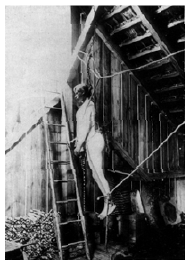 An elderly, naked man, hands and genitals tied up, hanged. Autoerotic fatalities entered medical literature, when the german doctor Bernt took a special interest in this case in his paper on suicides (1821). But he reached the wrong conclusion and mistook it for a suicide with an insane twist. It took another century before attention was paid to the sexual aspects of such death scenarios. Again, it was a german forensic, Ziemke, who in 1926 finally identified and consistently described these cases as accidental deaths caused by strangulation as a means to sexual arousal.
1. The upright hangman
In the times of public executions it was common knowledge that hangings occasionally provoked erection and ejaculation. This reflex is probably caused by the snapping of the spine, but it could easily be misinterpreted as a sign of sexual pleasure. An engraving by Dürer shows a torture chamber filled with skeletons in chains, a hanged man ejaculating, and another being whipped. There are a number of references in 18th century literature. The most prominent is found in Marquis de Sade's Justine (1791), where Thérèse helps Roland achieve an orgasm by hanging him briefly. Afterwards, he exclaims: "Oh, Thérèse! Oh, these feelings are undescribable! They exceed everything!"
A few months after Justine was published, the first documented death by sexual strangulation occurred in London. It happend to Franz Kotzwara, composer and one of the greatest double-bass players in Europe, but an even greater libertine of the sado-masochistic variety. September 2, 1791, he payed a visit to the prostitute Susannah Hill on Vine Street no. 5. He gave her 2 shillings to buy some ham, beef, porter and brandy, and after their dinner he asked her to cut off his genitals. She declined, but complied with his wishes to be satisfied by strangulation. Kneeling, he hung himself with a rope tied to the doorknob. Five minutes later he was dead. Susannah Hill was arrested and charged with murder, but was acquitted after testimony proved her innocence. The court records were destroyed to prevent the scandalous case from going public. A secret copy was made, though, to be sold and published at a later time. It never was, but the manuscript is preserved and kept in the Francis Countway Library of Medicine in Boston.
The story did get out, however, and was hinted at in the newspapers. The year after, it was discussed at length in an anonymous pamphlet Modern propensities; or, An Essay on the Art of Strangeling, & c. Illustrated with Several Anecdotes. With Memoirs of Susannah Hill, and a Summary of her Trial at the Old Bailey on Friday, September 16, 1791, on the Charge of Hanging Francis Kotzwara, at her Lodgings in Vine Street, on September 2 (J. Dowson, London 1791). It runs some 46 pages, the first 29 being devoted to a preamble discussing the putative effects of hanging on the body's physiology, while only the last seven pages deal with Kotzwara and Susannah Hill.
It further accounts an earlier incident concerning a certain Reverend Manacle, who was working in the Newgate prison. He wasn't known to limit himself to administering spiritual support, and had contracted a veneral desease that rendered him impotent. Observering the effects of hanging renewed his hope. He approached a female prisoner, Mrs. Birdlime, who was sentenced to death for shoplifting. He pretended that he wanted to demonstrate with his own body how painless it was to be hanged. She was persuaded, and assisted him in the act. When he was cut down and regained consciousness with the expected erection, she agreed to have sex with him as a reward for his sacrifice. Manacle repeated this act with other women prisoners, and ended up killing himself in the process.
The pamphlet proceeds with Dr. Graham's Celestial Electric Bed and on to the assertion that "If ... the most robust and youthful require certain aids to ascend the upper sphere of conjunctive transports, what must be the situation of those elderly and antiquated PEERS and COMMONERS?" It cites the example of General S. who suffered from "a certain corporeal debility which prevented him from regular enjoyments." This is followed by a brief digression on the pleasure of pain and flagellation as a sexual stimulant. Then the ultimate fix of strangulation and death is introduced, disclosing that it was the notorious Jonathan Wild who first discovered, while examining the pockets of hanged felons, that "They evinced certain emotions and commotions, which ... proved that all flesh must die to live again."
From this masochistic angle the pamphlet describes in detail "the sublime science of strangulation" and the "lively sensations" it provokes. It suggests ways to lessen the visible physical marks and permit greater security and control, referring to "the celebrated Patent Inventor of Spring Bands, on Mount Street, who, from his wonderful improvements in surgery and mechanics, could very probably invent not only a safe but an agreeable and graceful mode of suspension." Turning itself into an odd advertisement, the pamphlet concludes with a promotion for "elastic garters" for selfhanging and a product from the same inventor called "Vanbutchell's Balsam of Life".
 It might be a satirical text, but it is probable the excentric quack Martin Vanbutchell himself wrote the pamphlet. At that time he placed advertisements in the papers that praised hanging and strangulation as a means to sexual satisfaction (supposedly in hope of creating a demand for his products). It might also be Vanbutchell, who is the author of some articles on strangeling in The Bon Ton Magazine (1793). The first one explores The Origin of Amorous Strangulation, while the other discusses The Effects of Temporary Strangulation on the Human Body. The tragic end of Kotzwara is told once more, illustrated in a print that depicts a smiling Susannah Hill in the process of placing a noose around Kotzwara's neck. He sits in front of the fatal doorknob with a glas and a suggestive bottle in his hand that leaves no doubt about the sexual aspects of the act. Thanks mainly to Vanbutchell and his twisted interests in propagating the case, sexual strangulation has since then also been referred to as "kotzwarism" in the proud tradition that christens sexual specialities after their prime exponent.
Scientific sex research did not share Sade's and Vanbutchell's positive attitudes towards the euphoric pleasures of strangulation. On the contrary, it viewed bodily pleasures and sexuality from the perspective of the "civil" bourgeois norms, which society as a whole was subjected to throughout the19th century. The morals condemned sexual activity as "irrational" and "deviating" except for the quick, procreational back and forth in the matrimonial bed. The whole spectrum of sexuality was thereby turned into a medical issue, being dealt with in terms of disease, diagnostics and classifications, with matching etiologies and normalising treatments in psychiatry (sex as insanity) and legal medicine (sex as crime). This was the case for masturbation, which was associated with sickness, insanity and death, and even more so for autoerotic satisfaction by strangulation. It was studied in connection with mental disorders in textbooks on sexual pathologies that proliferated toward the end of the century.
The pioneering work was done in Vienna, the breeding ground for psychoanalysis, as well as sexology in the Institute for Sex Research. Their dissertations on sexual practices and preferences reflected the uneasy sexuality of the times as much as the "perverse" nature of the subjects. There are discussions of sexual strangulation in works by Eulenburg (1895), Stekel (1929), Ellis (1936), and the first recent mentioning of Kotzwara's story occurred in Hirschfeld's Sexual Anomalies: The Origins, Nature and Treatment of Sexual Disorders (1948). It was partly due to these and other sexological descriptions that forensics, by and by, was able to identify and explain certain deaths as accidents in the process of sexual selfstrangulation. It was isolated at last and defined as a clinical entity by the german Schwarz in 1952, and later given the scientific name "sexual asphyxia" by Brittain in 1968.
Chap.2