The Teddy Valentine Story
You don't ask yourself why this lounge revival ever came about - you,
as anyone would, know that the clothes look good and that the music sounds
fantastic. Rather, you wonder why they went out of fashion. You would,
no doubt, feel this way about Teddy Valentine as well. The trouble is that
his records are very hard to find, and today it's doubtful that anyone
will be playing his songs on the radio - yet.
When you hear him, and get that feeling - the feeling of being in tune
with the people back then that were listening to his songs - you are all
wrong. Teddy Valentines music was never recognized among a larger audience
and was kept off the radio station hit-lists. With the revival of other
Lounge artists there has also been a discovery of one of the best artists
in the genre, Teddy Valentine. It could be that the time for Teddy Valentine
is now.
Truth is, Teddy couldn't see eye to eye with his producer who wanted to
make him just another hit-list artist. Saying "no" to the producer
also meant saying "no" to promotion. His music became limited
to an exclusive inner circle of the easy listening scene. With the new
release of his album Bullet of Love from 1969,
you too could become a member of the informed minority.
The re-release of Bullet of Love is to be announced at the end of March,
1997.
 The man in the picture to the left, Kent Åkerblom, claims that
Teddy Valentine no longer exists, that his story is over. He insists that
Teddy hasn't been around since just after the release of his last album,
"Music For A Lovely Girl." The same man, Kent Åkerblom
was once, at least to his audience, known by the name Teddy Valentine.
The man in the picture to the left, Kent Åkerblom, claims that
Teddy Valentine no longer exists, that his story is over. He insists that
Teddy hasn't been around since just after the release of his last album,
"Music For A Lovely Girl." The same man, Kent Åkerblom
was once, at least to his audience, known by the name Teddy Valentine.
Teddy / Kent Åkerblom was born in October, 1942, in Västerås,
a mid-sized industrial town in the middle of Sweden. Coming from a family
with a musical background, he started playing the flute at an early age.
He formed his first band, The Marmalades, in his early teens, and enjoyed
a bit of success. The status as a local hero was not enough for Kent, so
he decided to leave in '64, and moved to Del Mar, California, to stay at
his aunts place. He quickly became acquainted with the LA music scene,
where his natural talent made him a useful behind the scenes man at recording
sessions, and a well known face at the after parties.
Despite respect among his colleagues, success with his own orchestra, founded
in '67, was slow in coming. Mostly getting gigs at the tourist spots south
of the border, like the Rosarita Beach Hotel in Ciudad Juarez, and in the
land locked states of the Western Frontier. A minor break came for Teddy
when he was asked to appear at Fenders in L.A. It was here that the first
steps toward a contract with BCM Records came about. His first album, "Teddy
Valentine", was released at the end of '68. But, his collaboration
with his record company was doomed from the start.
Teddy had developed his own distinct style that did not fit into the mainstream
sound that his first producer George Swan was going for. His proper laid
back yet raunchy style was the beginning of an even more spaced-out, wilder
instrumentation, and his use of stereo, reverberation and sound effects,
made Swan lose his temper and wanted him out of the studio when Teddy proposed
the recording of "Bullet of Love". That album caused a split
with the company, not only for it's off beat sound, but also for it's shocking
album cover that Teddy insisted on, being his inspiration for the title
track. His flute was prepared with both echo and large reverberation that
made a very distant windy sound, a special trademark for Teddy which led
to his next album: "Teddy Valentine Plays The Sounds Of The Wind".
 Because of the halting relations with his record company and producers,
his albums didn't get properly promoted for the play lists of the radio
stations. The record was selling poorly. An unexpected encouragement came
to Teddy in '70 when he was invited to Las Vegas to play at the Parkway
Inn. Not one of the larger scenes in that town, but an invitation to Las
Vegas was a well earned recognition, and a goal he long had aimed for.
Because of the halting relations with his record company and producers,
his albums didn't get properly promoted for the play lists of the radio
stations. The record was selling poorly. An unexpected encouragement came
to Teddy in '70 when he was invited to Las Vegas to play at the Parkway
Inn. Not one of the larger scenes in that town, but an invitation to Las
Vegas was a well earned recognition, and a goal he long had aimed for.
After a series of engagements in Las Vegas, Teddy disappeared from the
stage and the public scene for over two years. Our sources have very little
to tell about this period, other than that it was during this time that
he met and married his wife Miriam, a beautiful girl of Haitian heritage.
To prepare for the release of his fourth and last album "Music For
A Lovely Girl" Teddy moved with his wife to Miami. The move to Miami
also meant the end of his musical career. Teddy Valentine again became
Kent Åkerblom.
Apparently Teddy had been building up debts during the period between his
last two albums,  debts that the marginal sales of his last album
could not manage to raise. Teddy got involved with business related to
the religious heritage his wife brought in to the family. Though most of
the charges brought against Teddy were relatively obscure, he was convicted
on a technicality and had to do some time before somehow managing to get
freed on bail. The whole affair never became stuff for the media. Though
Teddy managed to get out of the whole affair without much damage, he did
seem to have lost that always-shiny face in the process.
debts that the marginal sales of his last album
could not manage to raise. Teddy got involved with business related to
the religious heritage his wife brought in to the family. Though most of
the charges brought against Teddy were relatively obscure, he was convicted
on a technicality and had to do some time before somehow managing to get
freed on bail. The whole affair never became stuff for the media. Though
Teddy managed to get out of the whole affair without much damage, he did
seem to have lost that always-shiny face in the process.
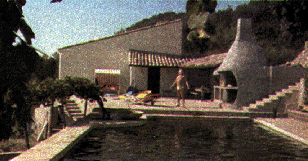
Today Kent Åkerblom is running a small business together with his
wife with Haitian heritage. The picture below was taken at his home in
a Miami suburb.
When asked about his former career as an orchestra leader and lounge musician,
Kent Åkerblom dismisses the whole period offhandedly. For him the
Teddy Valentine story ended long ago, for us it has just started.
Is there anything left of Teddy? Rumor has it that he appeared at a reception
for one of his former colleagues at a show in Pasadena, last year.
Today with the renewed interest for easy listening, there might be a new
future for Valentine, if only he would be there to meet it.